
How to name or rename your boat in NZ
Choosing a name for your boat can take longer than choosing the boat. The name ends up on the transom, in your VHF calls and on your paperwork, so it pays to get it right. Boat names in NZ also come with a few practical rules that plenty of owners don't know about.
Writing for Boating NZ, Lindsay Wright summed up why it matters. "Of all a person's possessions, his/her boat is the only thing that almost always carries a name." Legend has it that every boat name is entered in the "Ledger of the Deep" and known to Poseidon and Neptune. As Wright points out, "in this part of the world there is also Tangaroa."
Do you have to name your boat in NZ?
There's no national law that says a recreational boat must have a name. Many regional councils do require boats to carry clear identification, though, and a name is one way to meet that rule.
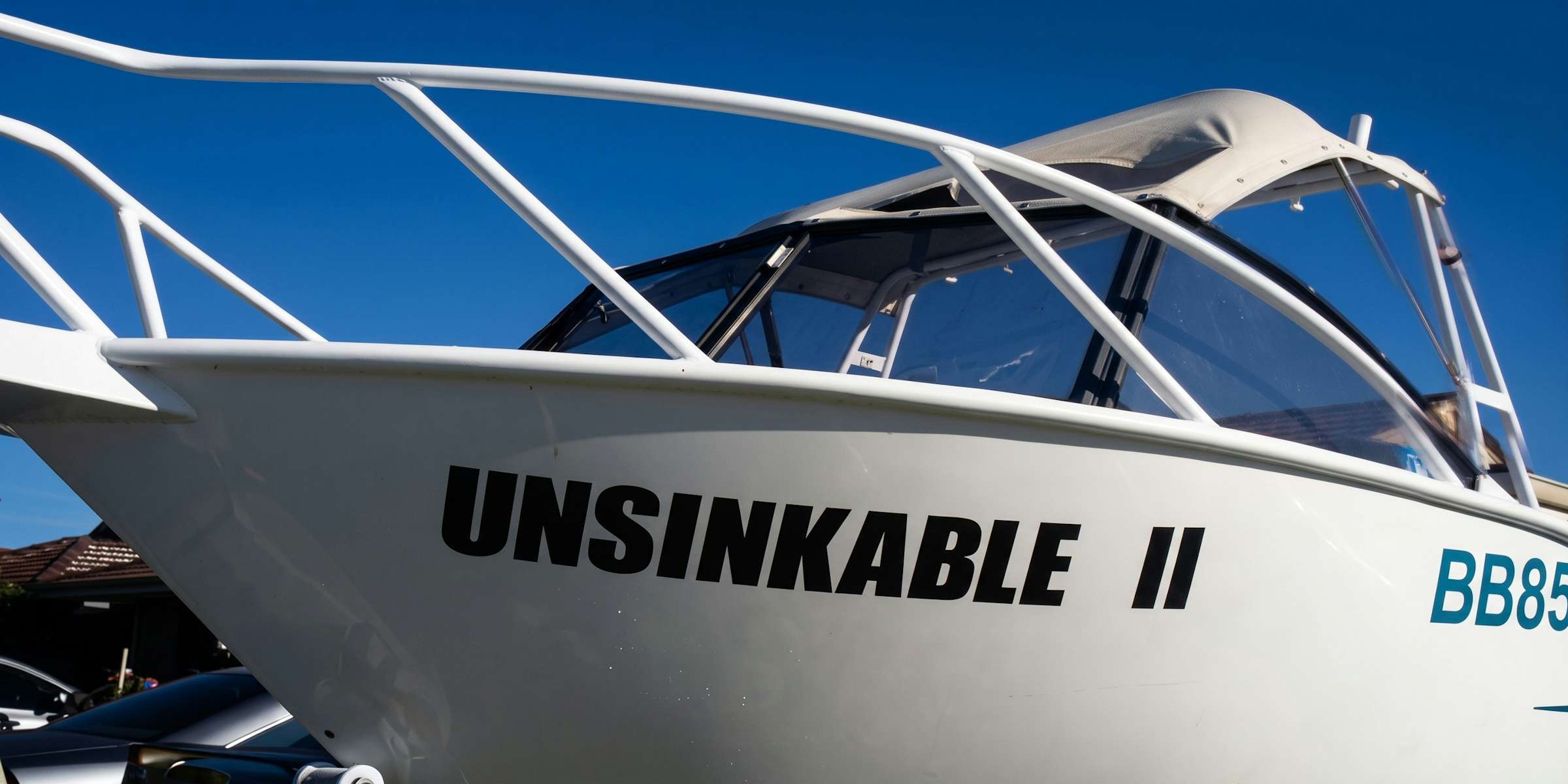
In Auckland, Waikato and Bay of Plenty, powered boats 4 metres and over and non-powered boats 6 metres and over must be marked with a name or number. The mark needs at least two letters or numbers, can't be the boat's brand, make or model, and must be clearly legible. Waikato and Bay of Plenty measure that at 50 metres. Auckland and Waikato also set a minimum letter height of 90mm, and Waikato wants the marking on both sides of the hull above the waterline.
Canterbury goes further. Every boat in the region, jet skis included, needs an identifying number on each side of the hull at least 90mm high. A trailer registration number, VHF call sign or Maritime NZ number all count, and non-powered boats under 6 metres just need the owner's name and phone number on board.
The rules differ from region to region, so check with your regional council or harbourmaster before you paint anything. If you trailer your boat around the country, marking both sides in 90mm letters that can be read from 50 metres is a sensible default.
Boat naming rules worth following
Beyond the identification rules, a few principles keep a boat name safe and practical.
- Don't make it sound official. Waikato's rules say a name must not be able to be mistaken for a harbourmaster, Coastguard, police, customs or fisheries vessel. Anything that sounds like a patrol or rescue boat is best avoided everywhere.
- Stay clear of distress words. Mayday, Pan Pan and Securite are the VHF calls for distress, urgency and safety messages. A name that includes them, or one that sounds like a call for help such as Man Overboard, could cause confusion in a real emergency.
- Keep it short and easy to say. You'll use the name on the radio, sometimes in wind and poor reception. A name of two or three syllables that can't be misheard is easier for everyone.
- Check it isn't taken. Yachting NZ won't register a name that duplicates or sounds like an existing registered boat. Search its register before you commit, particularly if you plan to race.
How to choose a good boat name
The team at My Yacht Management suggests treating a boat name like a tattoo. "Take it seriously; it cannot be undone easily; make it feel personal like it matches your personality."
A few simple tests help narrow down the shortlist.
- Say it on the radio. Try "Coastguard, Coastguard, this is" followed by your name. If it feels awkward or needs spelling out, keep thinking.
- Picture it on the hull. Long names need smaller lettering, which can make it harder to meet 90mm identification rules.
- Think about your audience. A cheeky pun that gets a laugh at the boat ramp can land differently on channel 16.
- Pick one that makes you smile. You'll say it, write it and hear it for years, so it should feel like yours.
If you're drawn to a te reo Māori name, take the time to check its meaning and pronunciation with someone who knows the language. It's a good way to give your boat a name with real connection to where you boat.
Boat name ideas
Plenty of Kiwi owners look to their jobs, hobbies or a good pun. Think Just Desserts for a judge, Flat White for a café owner, Knot on Call for a doctor or Plead Insanity for a lawyer. Designer puns work too. Lindsay Wright recalls two centreboard yachts built to an early Bruce Farr design and named Farr Canal and Farr Q!
Fishing boats are a rich source of wordplay. A few ideas to get you started are below.
- Reel Therapy
- Bait Expectations
- Knot Working
- Sick Day
- Reel Estate
- Kahawai Kid
- Fin and Tonic
- The Office
Whatever you choose, run it past the tests above and check the Yachting NZ register before the signwriter gets to work.
Can you change the name of a boat?
Yes. There's no general rule that stops you renaming a recreational boat, and plenty of owners do it after buying a boat second-hand.
Sailors have long believed renaming brings bad luck unless the old name is removed first and a ceremony is held. Tradition says every trace of the old name should go, from the transom and lifebuoys to the logbook, before the new name appears. Boating NZ covers the ritual for anyone who would rather not take chances with Tangaroa.
Your boat renaming checklist
Superstition aside, a new name means updating a few records.
- Hull markings. Remove the old name completely and add the new one in line with your regional identification rules.
- VHF call sign. Your call sign record holds your boat's details, including its name and colour. Coastguard Boating Education lets you update them free of charge. If you're new to call signs, our guide on why you need a call sign covers the basics.
- Distress beacon. The NZ beacon registration form records the vessel name, so update your details at beacons.org.nz. Maritime NZ notes that registration is a legal requirement and recommends keeping your details up to date. Not sure which beacon suits your boat? Our comparison of EPIRBs and PLBs can help.
- Yachting NZ registration. If the boat is on the Yachting NZ register, contact them to update the record.
- Your insurer. Let your insurer know about the new name so your policy details match your boat.
- Everything else. Lifebuoys, the tender, the logbook and your marina or mooring provider's records may all carry the old name.
Boat name FAQs
Can two boats have the same name?
Yes. Nothing stops two unregistered recreational boats sharing a name. Yachting NZ won't register duplicate or similar-sounding names, and your VHF call sign is what identifies your boat on the radio.
Do you have to register a boat name in NZ?
Not for most recreational boats. Yachting NZ strongly encourages registration and requires it for racing boats. Ships on the New Zealand Register of Ships go through a separate process with Maritime NZ.
Can you rename a boat when you buy it?
Yes. Once the sale is through, follow the checklist above. If the previous owner is keeping their call sign, you'll need to apply for your own or ask them to transfer it to you in writing.
Sources: Boating NZ, Auckland Transport, Waikato Regional Council, Bay of Plenty Regional Council, Environment Canterbury, Yachting New Zealand, Coastguard Boating Education, Maritime NZ, My Yacht Management