
How to avoid propeller and vessel strike injuries in NZ
Propeller strikes are among the most serious injuries that happen on New Zealand's waterways. They are fast, catastrophic, and in most cases entirely preventable. The injuries are severe, causing deep lacerations, fractured bones and severed limbs, and the people involved are usually swimmers, divers, or passengers who had every reason to believe they were safe.
ACC accepted 4,148 water-related injuries from recreational craft activity in 2023 alone, at a cost of $13.5 million. Maritime NZ's research shows an average of 18 people die on New Zealand's recreational waterways every year. Propeller and vessel strikes are a significant part of that picture, and the common thread through most incidents is the same: a skipper who wasn't paying attention, a situation that escalated quickly, and a safety step that was skipped.
Maritime NZ has stated it is concerned about the number and seriousness of propeller strike incidents in New Zealand waters, noting that propeller strikes can cause severe and often fatal injuries. That's not a vague caution. It's a direct response to what investigators keep finding after these accidents.
How propeller strikes happen
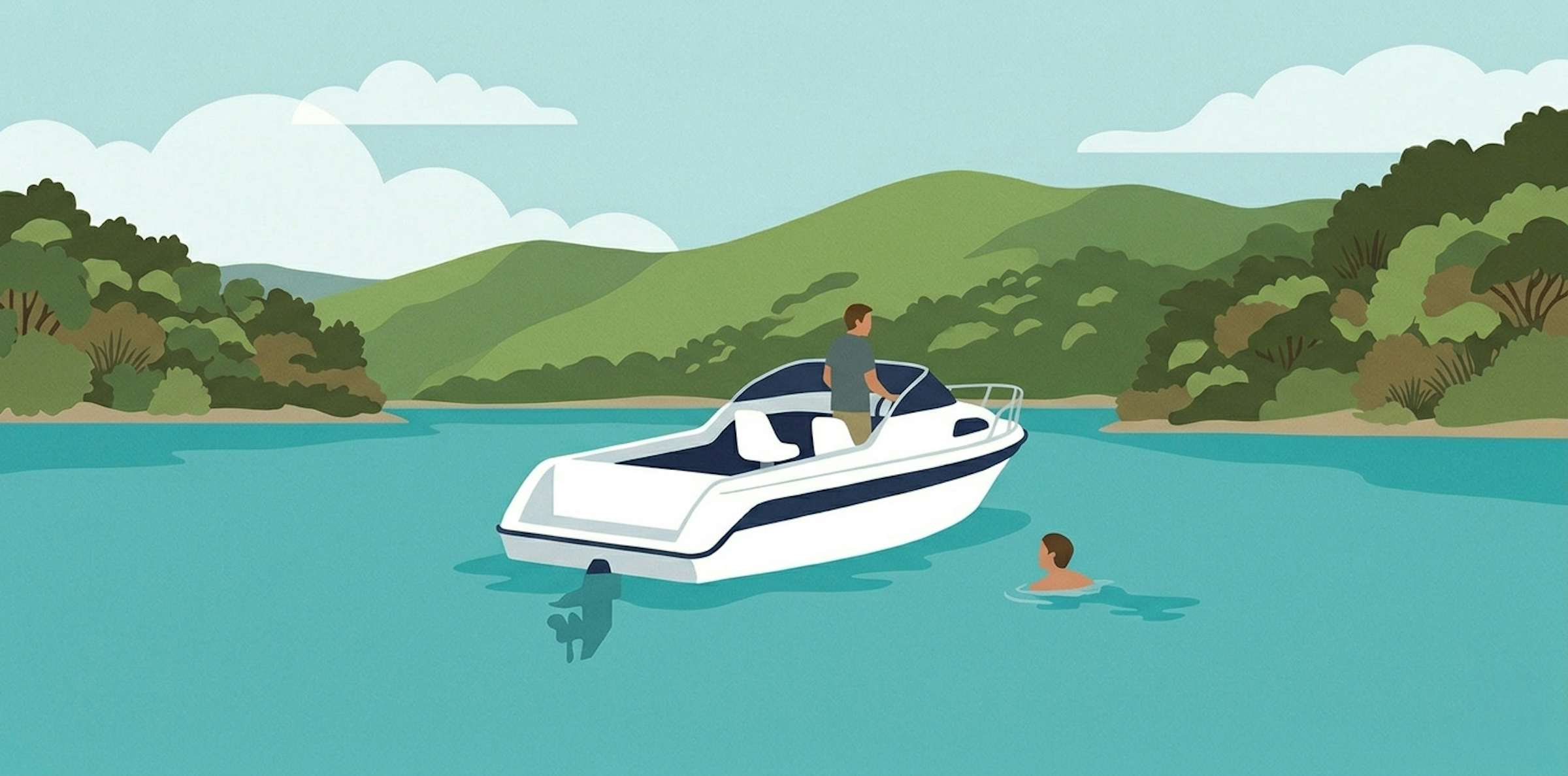
Most propeller strikes don't happen in unusual conditions or extreme situations. They happen on calm summer days, close to shore, often when people are swimming near or off an anchored or idling boat.
Common causes include:
- Alcohol. A 2022 Christmas Eve incident near the Alderman Islands ended with two women seriously injured by a spinning propeller after a day of drinking on board. The skipper was convicted in the Thames District Court in December 2025 under the Maritime Transport Act 1994. There is currently no blood alcohol limit for recreational boat skippers in New Zealand, unlike the legal limit that applies to drivers.
- Passengers in the water when the engine is running. A propeller spinning at speed can travel a significant distance in a very short time. The engine does not need to be in gear to cause injury. Even a rotating propeller at idle poses a real risk to anyone in the water nearby.
- Divers and dive boats. Maritime NZ has investigated multiple incidents where a diver surfaced near a vessel whose skipper did not know they were there, or where the hazard of propellers was not included in the vessel's safety procedures at all.
- Poor lookout at speed. Maritime NZ is clear that it is the skipper's responsibility to stay alert for other boats, swimmers, dive boats, and kayaks at all times, especially when travelling at speed. Glare, waves, and distraction all reduce visibility.
- Boarding and disembarking. Injuries regularly occur when passengers enter or leave the water from a swim platform while the engine is still running. Boarding ladders and swim platforms are danger zones if the propeller has not been confirmed as stopped.
What skippers need to do
As the skipper, responsibility for what happens on and around your vessel sits with you. These are the steps that matter most.
Use your kill switch every time
A kill switch (also called an engine cut-off device) is a lanyard or wireless device that stops the engine automatically if the skipper is thrown overboard or moves away from the helm. It is your single most important safety device for preventing a runaway vessel from striking people in the water.
The lanyard should be attached to you personally whenever the vessel is underway, not to the console and not clipped loosely to your belt. If you lose control of the boat, it has to be able to stop the engine. Test it regularly and replace it if it shows signs of wear.
Stop the engine before anyone enters or leaves the water
This rule is non-negotiable. Before anyone swims, dives, boards from the water, or approaches the swim platform, the engine must be off, and the propeller must have stopped turning. A propeller continues to spin for several seconds after the engine is cut, so wait until it is completely still. Confirm it verbally with everyone on board.
Check the water before you start the engine
Walk around your vessel before starting the engine. Look under the boat and at the swim platform. Confirm no one is in the water near or under your hull. This is especially important at anchorages and in popular swimming spots where children and swimmers may not be visible from the helm.
Don't allow passengers to sit on the bow, transom or gunwales
All it takes is one unexpected swerve, a wake, or a rough patch of water. A passenger on the bow or hanging off the transom is one bounce away from being in the water while the engine is running. Make sure everyone is seated properly before getting underway, and keep children visible and supervised at all times.
Keep a proper lookout, especially at speed
Maritime NZ's rules on the water are clear: it is your responsibility to stay alert for other vessels, swimmers, divers, kayaks, and paddle craft. Never assume the water ahead is clear. Sun glare, waves, and activity on board all reduce your ability to see what's in front of you. Reduce speed in areas where swimmers may be present, and treat dive flags and buoys as a signal to slow right down.
Be careful with alcohol
New Zealand currently has no blood alcohol limit for recreational boat skippers, but that doesn't mean alcohol and boating mix well. Alcohol impairs judgement, slows reaction time, and reduces situational awareness. The Waikato incident made this clear: the skipper had been drinking all day before two women were struck by the propeller. Calls for a legal limit are growing, but the safest approach is not to drink if you are skippering.
What swimmers and divers need to know
Skippers bear the primary responsibility, but swimmers and divers can take steps to reduce their risk, too.
- Never assume you're visible. A swimmer's head at water level is difficult to see, especially with glare, chop, or other activity on the water. Use bright colours, swim buoys, and dive flags to make yourself noticeable.
- Use diver down signals correctly. In New Zealand waters, a diver down flag or buoy signals to other vessels that diving is underway nearby. Stay close to your flag, don't surface a long distance from it, and make sure the skipper of your support vessel knows your planned route and timing.
- Communicate clearly before entering the water. Agree on your plans with the skipper and everyone on board before you go in. Confirm a clear signal for when you're ready to come back aboard, and make sure the skipper confirms the engine is off before you approach the ladder or swim platform.
- Scan for boat traffic during safety stops. Divers: before surfacing, look up. Listen for engine noise. Take your time at safety stop depth, and surface away from anchor lines and directly under your dive flag where possible.
- Stay well clear of any vessel with an engine running. Even a disengaged propeller can cause serious injury. If a vessel near you starts its engine while you are in the water, move away from the hull immediately.
Propeller guards: do they help?
Propeller guards are devices fitted around the propeller to reduce the severity of contact injuries. They are not mandatory on recreational vessels in New Zealand, and their use is debated in the boating community. Some guards can cause drag and performance issues, and certain designs are less effective at high speeds.
That said, for vessels operating at low speeds in areas where swimmers are regularly present, such as family anchoring spots, popular bays, and swimming holes, a propeller guard or propeller cage adds a layer of protection. If you operate a smaller vessel in these conditions regularly, it is worth discussing the options with your marine dealer.
No guard replaces the fundamental rule: engine off, propeller stopped, confirmed, before anyone enters or exits the water.
If someone is struck
Propeller injuries are traumatic and bleed heavily. If someone is struck:
- Call for emergency assistance immediately on VHF Channel 16 or 111. Don't delay this step.
- Stop the engine before recovering the person from the water.
- Apply firm pressure to wounds. Use whatever is available, such as clothing, towels, or a first aid kit. Maintain pressure during transit.
- Keep the person as warm and still as possible and monitor their breathing and consciousness.
- Head to shore or the nearest point where emergency services can meet you. Do not wait on the water for help to arrive unless there is no other option.
A solid first aid kit and at least basic first aid training are things every skipper should have. Coastguard Boating Education offers courses that include emergency response on the water.
Sources: ACC / Safer Boating Forum, Maritime NZ, Maritime NZ Lookout magazine, Maritime NZ Safer Boating Week 2024, Scoop, Boating NZ, Coastguard Boating Education